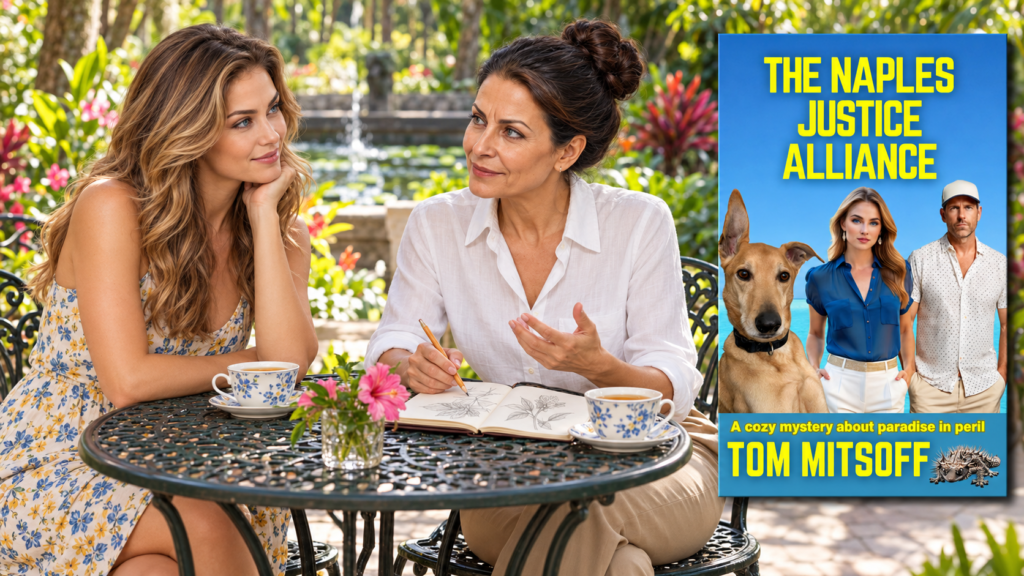
Fictional illustration created with AI using the author’s character references and book cover. Monique and Anna share a conversation in a garden café.
By Tom Mitsoff
Florida’s latest lionfish tally adds up to a considerable amount of work: 533 participants, 1,468 dive trips and 36,187 invasive fish removed. In its October 19 report, the Florida Fish and Wildlife Conservation Commission described record participation and removals in its completed summer challenge.
Those numbers measure a collective effort. They also invite a smaller question: where does someone’s involvement begin?
In my novel, The Naples Justice Alliance, a friendship that becomes important to the investigation began with an environmental workshop and a problem in Monique Tate’s garden. She had a weed she could not get rid of. Anna Santos had knowledge she was willing to share.
The plant was Brazilian peppertree. Anna, a wildlife biologist whose work includes invasive species, could explain what Monique was dealing with. Monique brought something equally necessary to the conversation: a specific problem, an interest in understanding it and a willingness to ask.
Three years later, the two women still remember that meeting. Their shared interest has grown into a friendship, with regular conversations and an easy familiarity that matters when Monique needs help with a more troubling question.
That history gives their partnership a foundation. Anna does not enter the story simply because an investigation requires a scientist. She is someone Monique already knows, respects and trusts enough to call.
For readers who enjoy an ensemble mystery, those connections can be part of the pleasure. A character’s expertise becomes more interesting when we understand how another person came to value it. A friend who knows whom to ask can be as important to an investigation as the person who knows the answer.
Monique’s public life might suggest that her most useful connections would come from the modeling world. But the garden problem introduces a different part of her life. Her interest in the place she calls home brings her into contact with someone whose work helps her understand it.
Anna gains a friend who cares enough to keep asking questions. Their conversations have room for concern, curiosity and the satisfaction of discovering that another person takes the same things seriously.
The lionfish challenge offers a real-world example of people applying their abilities to an environmental problem. Recreational divers and commercial harvesters contributed to the effort. The removal total is a result of that work; it should not be mistaken for a declaration that Florida’s lionfish problem has been solved.
The novel follows a different, fictional crisis. Its characters face questions that cannot be answered by borrowing the response to a real species. What carries across is the human connection: concern becomes more useful when people can bring their observations to someone with relevant knowledge.
When Monique turns to Anna, she has more than a name to look up. She has three years of conversation behind the call. The reader has a reason to believe that these two women will listen to each other, even when what they are hearing becomes difficult.
A weed is a small beginning for a friendship that will matter to a mystery. It also gives readers something worth noticing before the larger questions take over: these people have a life together beyond the problem they are trying to solve.