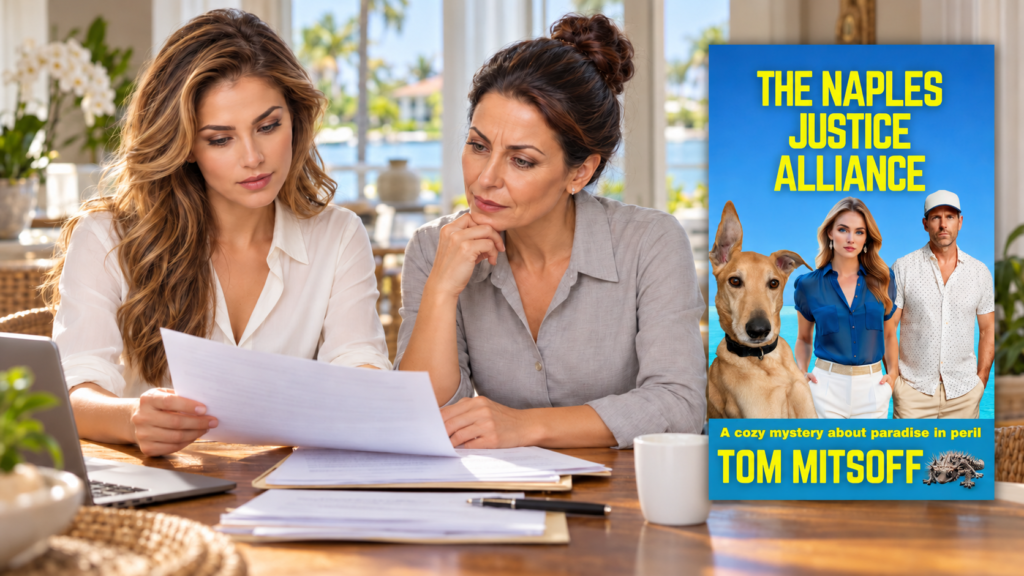
Fictional illustration created with AI using the author’s character references and book cover. Monique and Anna compare information as their community faces uncertain claims.
A damaged home leaves its owner with decisions that cannot all wait. Repairs need attention. Insurance questions need answers. That urgency can also give a dishonest stranger an opening, especially when an offer of help comes with pressure to decide immediately.
Florida officials raised that concern after Hurricane Isaias. In an October 11 warning, the state Department of Financial Services cautioned residents about unlicensed contractors, adjusters and others who might exploit people dealing with storm damage. Recovery creates a need for trustworthy information at precisely the moment when people have a great deal to absorb.
That pressure has a fictional counterpart in my novel, The Naples Justice Alliance. The crisis confronting its characters is environmental, rather than a reconstruction of this hurricane. But the residents face a recognizable problem: someone arrives claiming to understand the damage, explains why their property is losing value and offers a way out before they have enough information to judge the offer.
Monique Tate sees what those visits could cost her neighbors. At a public meeting, a woman tells her that someone has offered to buy her property and salvage some value from it. The woman and her husband are trying to decide whether they need to sell. Their uncertainty makes the conversation more troubling than a simple dispute over price. They do not yet know what has happened to the place they own.
Monique wants the community to hear what she and her friends have learned. Anna Santos, the environmental scientist helping investigate the crisis, agrees. She also knows how quickly a frightened public meeting can become a confrontation. Before they face the crowd, she urges the group to distinguish what they know from what they think they have figured out.
That distinction gives the scene its tension. Monique feels the need to act before people make decisions they cannot easily undo. Anna understands that their own credibility depends on resisting the temptation to fill gaps with confident answers. Barry Pope brings his questions and research to the same effort. Each has something useful to contribute, and none can make uncertainty disappear by speaking louder.
The pleasure of this kind of mystery comes partly from watching those differences become a partnership. A neighbor recognizes the human consequences. A scientist limits a claim to what the evidence supports. Someone else notices a detail worth pursuing. Their work matters because the people listening still have choices to make.
Florida’s current recovery guidance offers a practical version of that pause for verification. It advises homeowners to contact their insurer before arranging repairs, check a contractor’s license and obtain written estimates from several licensed contractors. It also identifies pressure for an immediate decision or a large upfront deposit as a warning sign. Those steps give a homeowner something firmer than a reassuring voice to consider.
The novel takes that concern into a mystery, where the reasons behind an offer become part of the investigation. Monique and Anna must help people understand enough to make their own decisions while they are still working out the full story themselves. Protecting a community means earning its trust, one supportable fact at a time.
An offer can sound most convincing when it arrives at the worst possible moment. The question worth carrying into the story is who benefits if nobody stops to check it.